Wellborne
(757) 919-1972Get an Estimate

Wellborne: Well Pump Repair in Suffolk, VA

Most Suffolk house wells are deep. In a Virginia Tech clinic of 204 Suffolk homes, the average reported depth was 371 feet, so the pump that quit is usually a submersible hanging hundreds of feet down. We find out whether it is the pump, the controls or the water level before anything comes out of the ground.

Get an Estimateor call (757) 919-1972

Suffolk well depths, as owners reported them

Under 50 ft (dug, bored and shallow wells)17%
51 to 300 ft10%
Over 300 ft59%
Depth not known14%

Virginia Cooperative Extension, Evaluation of Household Water Quality in Suffolk, Virginia, from a clinic of 204 households.

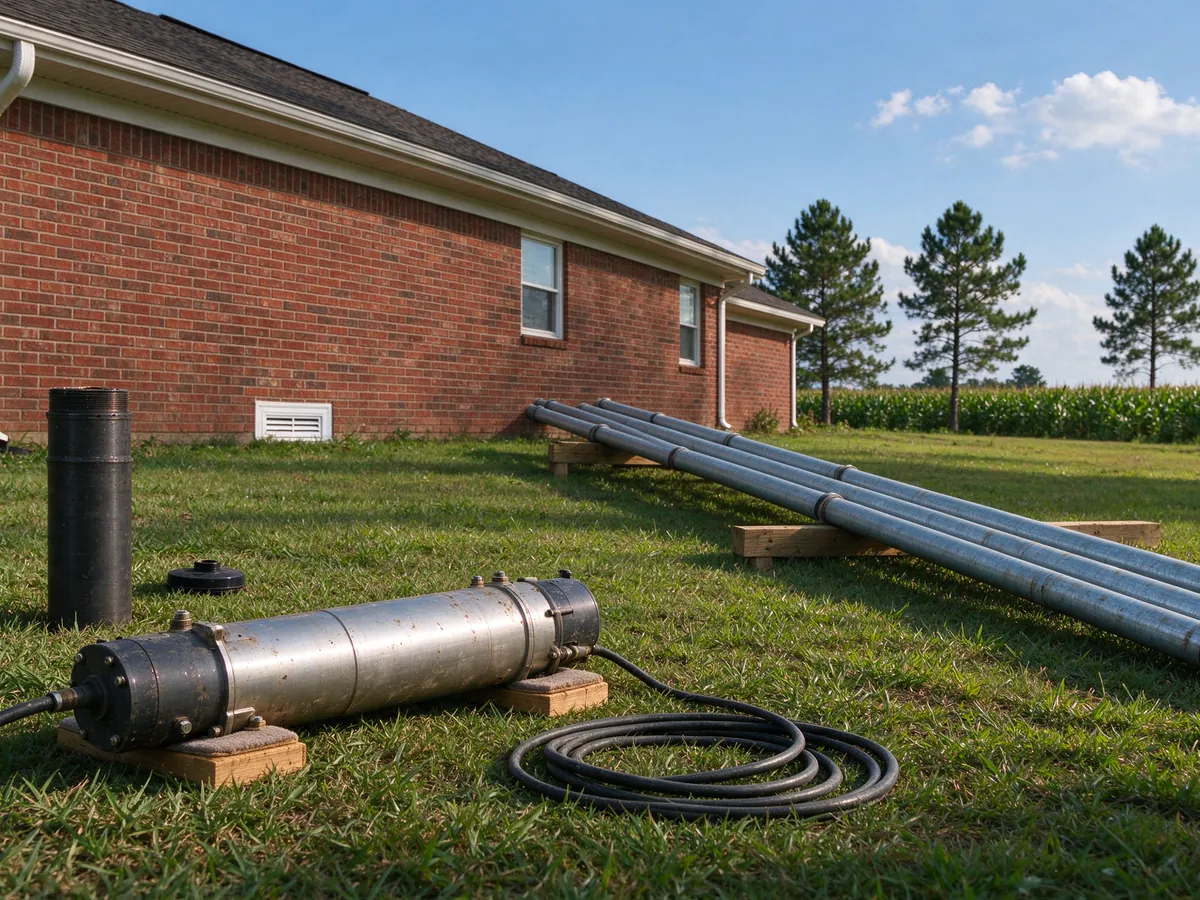
Submersible well pump on padded cradles beside an open steel well casing and lengths of drop pipe in a Suffolk, Virginia side yard
A pulled submersible pump on cradles, its cable coiled beside it, with the open casing and the drop pipe racked behind.

What the Virginia rules say

  • Replacing a well pump is not a well alteration under Virginia's private well rules, so it needs no health department well permit.
  • Virginia requires a well to be disinfected before it goes back into service.
  • Well and pump work in Virginia is done by water well systems providers certified through DPOR.
  • A new well needs a $300 Virginia Department of Health permit; sealing an old well at your own home needs a permit but no fee.

Well pump and well services

No water from the well

When the taps go dry, the pump is only one of four suspects, and replacing it first is how people pay for a pump they did not need.

Power and controls come first

We start at the breaker, the pressure switch and, on three-wire submersibles, the control box. A pitted switch contact or a failed start capacitor stops the water as completely as a dead motor, and both are repaired at ground level. After a thunderstorm or a power surge, these parts are where we look first.

Then the pump and the pipe

An amp reading tells us whether the motor is running and how hard it is working. Normal amps with no water at the tank points to a split drop pipe, a failed coupling or a stuck check valve. Very low amps can mean the pump is running dry.

Then the water level

If the pump is set close to the pumping level, a long irrigation run or a dry spell can pull the water below the intake. We check the level against the pump setting before recommending a new pump, because a new pump at the same setting would fail the same way.

Outside business hours

We take emergency calls outside our regular hours. If your pump is running with no water reaching the house, switching off its breaker protects the motor until we get there.

Well pump replacement and deep submersibles

A Suffolk well pump often hangs several hundred feet down, and that depth decides how the job is done and what it costs.

What comes out of the well

Replacing a submersible means lifting the pump, the motor, every length of drop pipe, the power cable and the check valves out through the pitless adapter. At 300 feet and more, that is a lot of pipe and wire to inspect. Splices, worn couplings and corroded fittings get replaced while the pipe is out, not left to fail next year.

Sized as one system

The new pump is matched to the well depth, the water level, the pressure switch range and the tank, not chosen by horsepower alone. An oversized pump on a modest well can pull the water down and short-cycle. An undersized one never reaches cut-out pressure.

Shallow wells and jet pumps

About one Suffolk well in six is under 50 feet: bored, dug or driven wells, often with a jet pump in a shed or crawlspace. Those pumps lose prime from small suction-side leaks, so we pressure-test the suction line before condemning the pump.

Before you drink from it

Opening a well lets surface bacteria in. Virginia requires disinfection before a well goes back into service, and we recommend a bacteria test once the chlorine has flushed through.

Pressure tanks, switches and controls

Most short cycling starts at the tank, not the pump, and a tank problem left alone shortens the life of a pump that was fine.

020406080100PSI

Gold band: a 40/60 switch range. Tank air charge: 38 psi.

The air charge

A bladder tank holds a cushion of air that should sit about 2 psi below the switch's cut-in pressure, so 38 psi on a 40/60 switch. When that charge leaks away, the tank holds very little water and the pump starts every few seconds. Sometimes recharging the air fixes it. A torn bladder means a new tank.

The switch and the control box

Pressure switch contacts pit and stick, the small sensing tube clogs with sediment, and control-box capacitors fail after surges. These parts are cheap next to a pump, which is why we test them before anything leaves the well.

Constant pressure systems

A variable-speed drive slows and speeds up the pump to hold one steady pressure, so a shower does not swing between strong and weak. It needs a compatible motor and wiring and still uses a small tank. On many deep Suffolk wells it is a worthwhile upgrade when the pump is being replaced anyway.

Signs it is the tank

Pressure that drops fast and climbs fast, a switch that clicks every few seconds, or a tank that sounds full when you tap the top all point to the tank. A leaking tank or rust at the seams means replacing it.

New wells, old wells and wells nobody uses

Drilling a well, deepening one or sealing an old one all need a Virginia Department of Health permit, and the rules decide where a new well can go.

HouseWell15 ft min.Septic tank50 ft min.Drainfield50 or 100 ft12VAC5-630-380, Table 1 (selected items)

Where a new well can sit

State rules keep a well at least 15 feet from a building foundation and 50 feet from a septic tank. Drainfields need 50 or 100 feet depending on how the well is built, so on a small rural lot the septic layout often decides the drilling spot. A construction permit is $300; sealing a well at your own home needs a permit but no fee.

What nobody can promise

No driller can guarantee depth or yield before the bit reaches the aquifer. Neighbouring well records and the county's geology narrow the estimate. In southwest Suffolk, USGS mapping shows one of the shallower aquifers missing, which pushes wells deeper.

Rehabilitate, deepen or replace

A well whose output has dropped may be clogged with iron and sediment, or the casing may be failing. Cleaning and redevelopment can restore a sound well. A failing casing usually means a replacement well, and the old one then has to be sealed.

Sealing an old well

Virginia treats a well as abandoned once its pump is disconnected for any reason other than repair. Sealing it means a permit (free for a well at your own home), chlorinating the bore and filling it with approved grout. Brick, broken concrete and fly-ash fill are not allowed.

Well water testing and treatment

Clear water proves nothing in Suffolk. The two most common problems in deep wells here are invisible and have no taste.

Suffolk clinic results, 204 households (Virginia Cooperative Extension)
Fluoride above 4 mg/L19%
Sodium above 20 mg/L78%
Coliform bacteria present21%
Rotten-egg odor reported19%

What Suffolk testing found

In the Virginia Tech clinic of 204 Suffolk homes, 19% of samples were above the federal fluoride limit of 4 mg/L, 78% had more than 20 mg/L of sodium, and 21% tested positive for coliform bacteria. About one household in five reported a rotten-egg smell.

Treatment follows the lab report

Each problem has a different fix. Fluoride and sodium need reverse osmosis at a drinking tap. Bacteria need the source found and corrected, then disinfection, with UV treatment where it keeps coming back. Iron and sulfur need their own filters. A softener removes hardness but adds sodium, so it is a poor choice on a well that is already high in sodium.

When to test

Test once a year for bacteria and after any work that opens the well, including a pump replacement. Get a full panel when you buy a house or when the taste, smell or color changes.

Testing is part of our pump work

After we disinfect a well, we tell you when it is safe to take a bacteria sample and how to collect it. If a full panel shows fluoride, sodium, iron or bacteria problems, treatment is quoted from those results, never from a guess at the tap.

How we work on a well

Test before we pull

Amp draw, pressure, switch and tank checks come before any pipe leaves the ground.

One system, sized together

Pump, tank and switch are chosen to match each other and the well, not by horsepower alone.

Figures you can check

Depths, rules and test results on this site come from Virginia agencies and university studies, and we name them.

Disinfect, then test

Every well we open is disinfected before use, and we tell you when to take a bacteria sample.

From the first call to the first glass of water

  1. The call

    Tell us what the taps and the pressure gauge are doing, roughly how deep the well is if you know, and whether there is any water at all.

  2. At the wellhead

    We test power, controls, tank and pump in that order, then explain what we found and what it will take before work starts.

  3. The work

    Repairs at ground level, or the pump and pipe pulled, inspected and reset, with the new parts sized to the well.

  4. Before you drink it

    The well is disinfected and flushed, the system is checked through full cycles, and we tell you when to sample for bacteria.

Water off right now?

Call and tell us what the pressure gauge reads. Emergency calls are taken outside regular hours.

Get an Estimateor call (757) 919-1972

What well pump work costs, and why it varies

We publish a range only where the evidence supports one. Prices for deep-set pumps and tanks depend on things we measure at the well, so for those we explain what moves the number.

Well pump replacement

$900 to $2,500

A national budgeting range for a pump and its installation, not our quote. Suffolk's deep wells often sit at or above the top of it because of the pipe, cable and pulling work at 300 feet and more.

Pressure tank replacement

Priced at the well

What moves it: tank size and drawdown, whether the switch, gauge and tank tee are replaced too, access in a crawlspace or well house, and whether the pump is being changed at the same time.

New well or abandonment

Priced from the site

What moves it: depth to a usable aquifer, casing and grout, rig access, setbacks and the $300 VDH permit. For abandonment: depth, the old pump and pipe, and the grout volume; no permit fee at your own home.

Try the cost estimator

What this site covers

How Suffolk wells work

Why Suffolk wells run so deep

Suffolk sits on Coastal Plain sand, clay and shell beds stacked hundreds of feet thick.

Most household wells reach past the shallow layers to the deeper confined aquifers, which is why 59% of owners in the Virginia Tech clinic reported wells over 300 feet. A deep well also explains the water: sodium and natural fluoride both rise in the deeper aquifers. Knowing which layer your well draws from tells you what pump it needs, how its water level behaves in a dry summer, and what to test for. The cornerstone guide walks through each layer from the surface sands down.

Matching a pump to the well

The right pump is set by four numbers: how far down the water stands at rest, how far it drops while pumping, how many gallons a minute the well can sustain, and the pressure range at the house.

A pump that outruns the well draws the level down until it sucks air. A pump too weak for the depth never reaches cut-out pressure. A good replacement starts with those measurements, not the horsepower stamped on the old motor. If a well has a drilling log, it records the casing depth and the yield measured when the well was finished.

Jet pumps and submersibles

Jet pumps sit above ground and pull water up by suction, which limits them to shallow wells, roughly 25 feet of lift for a single-pipe pump.

Submersibles sit down in the water and push it up, so they suit the deep wells most Suffolk homes use. Shallow bored and driven wells on older lots and irrigation wells still use jets. Their usual failure is a lost prime, not a burned motor. Deep-well jet pumps exist, but on wells hundreds of feet deep a submersible is far more efficient. Swapping a jet for a submersible means a new pump, pipe and wiring down the well.

When the pump stops or acts up

A breaker that keeps tripping

A pump breaker that trips straight away after a reset usually means a short: in the wire splice down the well, the motor windings, or a control-box part.

One that trips after a few minutes points to a motor overheating or straining against a stuck check valve. Resetting it again and again cooks the motor, so after a second trip, leave it off. A megohm test on the wire tells us whether the fault is in the well or above ground. Repairing a splice is a much smaller job than replacing a pump.

After an outage or a lightning storm

When the power comes back, a healthy system usually restarts on its own.

If it does not, check the breaker, then the pressure switch. Some switches have a low-pressure cutoff lever that has to be held up while the pressure builds. Lightning is the bigger risk in Hampton Roads summers: a nearby strike can kill a control-box capacitor or a switch, and sometimes the motor. We test those in order before pulling anything. A generator that is too small for the pump's starting current is another common cause of a dead pump after an outage.

A pump that hums but moves no water

A hum with no water usually means the motor is getting power but cannot turn.

On a three-wire submersible, the start capacitor or relay in the control box is the usual suspect, and it is fixed at ground level. On a jet pump, a seized impeller or a lost prime makes the same sound. A long hum heats the motor, so switch it off until it has been checked. Sand that has locked the impellers is another cause, and it shows up on the amp reading.

A pump that will not shut off

If the pump runs and never reaches the switch's cut-out pressure, water is going somewhere: a leak in the buried line, a toilet running, an irrigation zone left open, or a check valve letting water drain back down the well.

A worn pump or a falling water level gives the same symptom. A pump running dry overheats quickly, so this is worth a call the same day, not next week. Turning off every fixture and watching whether the pressure holds tells you whether the water is escaping in the house or back down the well.

Pressure and cycling

Rapid on-off cycling

A pump that starts every few seconds while a tap runs is short cycling.

Nine times out of ten the pressure tank has lost its air charge or its bladder has torn, so the tank holds almost no water between starts. Tap the tank: a waterlogged one sounds full to the top. Each start heats the motor and wears the switch contacts, so fixing the tank quickly protects the pump. A tank that is simply too small for the pump does the same thing, and so does a leak that drains pressure between uses.

Spitting faucets and air in the lines

Air bursts at the tap mean air is getting into the water on its way up.

In a deep well, that usually means the pumping level has dropped close to the pump intake. In a jet-pump system it usually means a suction leak. A failed bladder can also release air. Milky water that clears from the bottom up is dissolved gas, which is different, and is common in some Suffolk wells. Finding out which one you have decides the repair: lowering the pump, sealing a suction leak or replacing the tank.

Shallow wells and jet pumps

When a jet pump loses its prime

A jet pump needs its suction line full of water to work.

A cracked fitting, a leaking foot valve or a dropping water table lets air in, the pump loses prime, and it runs without moving water. Priming it again works until the leak opens up again. Finding the leak means pressure-testing the suction side and checking the foot valve, which is cheaper than a new pump that would lose prime the same way. Shallow wells also lose prime in dry summers when the water table drops below what the pump can lift.

Repair or replace, and what it costs

Repairing a part or replacing the pump

Switches, capacitors, tanks and wire splices are all repairable without replacing the pump.

The pump itself is worth replacing when the motor tests weak or shorted, or when worn impellers leave it unable to build pressure. Higher electric bills and slower recovery are the early signs. On a deep well, the cost of pulling the pipe argues for replacing a tired pump while it is already out of the ground. An amp reading and a megohm test on the motor and wire turn this from a guess into a measurement.

How long a well pump lasts

Pump life depends more on how the system runs than on the brand.

Short cycling, sand, running dry and power surges are what kill pumps early. A submersible with a good tank, a steady water level and clean water can run for many years. A jet pump in a damp crawlspace usually has a shorter life. Keeping the tank charged and the switch healthy is the cheapest way to make a pump last. Lightning arrestors and a correctly set low-pressure cutoff also protect the motor.

What moves the price of pump work

Depth is the biggest factor on a Suffolk job: every foot of pipe and cable has to come up and go back down.

After that come the pump and motor size, the tank and controls, wire replacement, access to the wellhead, and any trenching or wiring to the house. Homeowners insurance rarely covers a pump that wore out, though a sudden event such as a lightning strike is sometimes treated differently. Check your policy. The cost guide sets out each of these drivers.

Permits and who may do the work

Permits and licensing for pump work

Under Virginia's private well rules, replacing a pump, replacing a well cap or seal with an equivalent one, or extending the casing above ground is not a well alteration, so no health department well permit is needed.

Deepening, new construction and abandonment do need one. Whoever does the work should hold a water well systems provider certification from DPOR, the state's licensing agency. You can check any provider on DPOR's license lookup. A licensed plumber can do work covered by the plumbing code, but the well itself is the well provider's job.

What is in the water

Testing after the well has been opened

Pulling a pump exposes the well to surface bacteria, which is why Virginia requires disinfection before the well goes back into use.

After the chlorine has been flushed out, a bacteria sample confirms the result. Lenders usually want bacteria, nitrate and lead results for a sale. For deep Suffolk wells, adding fluoride and sodium to the test is worth the small extra cost. Virginia Tech's extension program runs low-cost testing clinics around the state, and certified private labs test year-round. Sampling from a cold tap after the water has run a few minutes gives the cleanest result.

Rotten-egg smell

A sulfur smell came up in about one Suffolk household in five in the Virginia Tech clinic.

If it shows up only in hot water, the water heater's anode rod is often reacting with the water, and that is fixed at the heater. If both hot and cold taps smell, the gas is in the well water itself and needs treatment chosen from a test. Either way, it is worth testing for bacteria too. Shock chlorination can clear a smell caused by sulfur bacteria, though it often comes back.

Orange stains and red slime

Iron stains fixtures orange and laundry rust-brown.

A red-brown slime in toilet tanks is usually iron bacteria, which feed on dissolved iron and can foul the pump screen and the well itself. Shallow wells in the surface sands tend to carry more iron than deep ones. Filters and periodic well treatment handle it, and the right choice depends on the type of iron the test finds. In the Suffolk clinic, iron was above the taste and staining guideline in only about 3% of samples. Most iron trouble here comes from shallow wells and old galvanized pipe.

Sand and grit at the tap

Sand in the water can mean the pump is set too close to the bottom of the well, a well screen has failed, or a new pump is surging and stirring up sediment.

Sand wears out impellers and clogs switch sensing tubes. A sediment filter protects the house but hides the cause. Raising the pump or repairing the screen deals with the source. In a newly drilled well, some sand in the first weeks is normal while the well finishes developing.

Storms and flooding

When floodwater covers the wellhead

Low ground near the Nansemond and the James can put water over a wellhead in a hurricane or a tidal surge.

Stay away from the pump's electrics until the power is off. Floodwater can enter through a loose cap or a cracked casing, so treat the water as unsafe until the well has been disinfected and a bacteria test comes back clear. Turbid or muddy water afterward means a full flush, not just chlorine. Pump motors and control boxes that were under water need testing before they are powered up again.

Buying a home with a well

Buying a house with a well

Virginia does not require a well inspection or water test at sale, but most lenders want a water test and buyers should want more.

Ask the local health department for the well record: wells from 2003 on are in VDH's electronic system, 1990 to 2003 records are on paper, and many older wells have none. A flow and pressure check, an equipment age estimate and a full water panel tell you what you are buying. Older bored wells with concrete or brick linings deserve a close look at the cap and seal.

New wells and old wells

What sets the cost of a new well

A new well is priced by depth, casing, grout, rig access and the pump system that goes in it, plus the $300 VDH permit.

In Suffolk, the depth to a usable aquifer is the big unknown, and in the southwest of the city one of the shallower aquifers is missing. Nearby well records give a planning depth. Nobody can promise the final depth or yield before drilling. Rig access matters on wooded or wet lots, and setbacks from septic systems can push the well site farther from the house, adding trenching.

Fixing a weak well or drilling a new one

A well that once produced well but has slowed may have a screen clogged by iron, scale or bacteria.

Cleaning and redevelopment can restore it for far less than a new well. A well with a cracked or collapsing casing, or one drawing from a layer that has gone salty or run short, is usually better replaced, and the old bore is then sealed under VDH rules. A recovery test, which measures how fast the water level comes back after pumping, shows which situation you are in.

The decision in front of you

OptionWhen it fitsWhat it involvesWhat we check first
Repair a control partPump runs normally once power and controls are sortedSwitch, capacitor, relay or wire splice at ground levelAmp draw and switch contacts
Recharge or replace the tankShort cycling, sputtering pressure, waterlogged tankAir charge set 2 psi under cut-in, or a new tank, tee and gaugePrecharge, bladder, tank size
Replace the pumpMotor shorted or weak, or worn impellersPull pump, pipe and cable, inspect, size and resetMegohm test, water level, pump setting
Pump plus constant pressurePump replacement on a deep well where steady pressure mattersVariable-speed drive, compatible motor, small tankWire size, motor type, household demand
Rehabilitate or drill newYield has dropped or the casing is failingCleaning and redevelopment, or a permitted new well and sealing the oldRecovery test, casing condition, records

Where we work

Suffolk and communities within about 30 miles. Well rules come from the Virginia Department of Health office that covers each area.

AreaHealth department officeWhat is different about the wells
Suffolk: Whaleyville, Holland, Chuckatuck, Driver, Crittenden, HobsonVDH Western TidewaterMostly deep wells, average reported 371 ft; shallow bored wells on older lots
Isle of Wight: Smithfield, Windsor, CarrolltonVDH Western TidewaterReported depths from 35 to 700 ft; 62% of county clinic samples had coliform
Virginia BeachVDH Virginia BeachShallow wells used mainly for irrigation; water below about 150 to 200 ft is too salty
Chesapeake, southernVDH Chesapeaken/a
Southampton County and FranklinVDH Western Tidewatern/a
Portsmouth, Norfolk and the PeninsulaVDH local officeMostly city water; irrigation wells and outlying homes

All service areas

Questions people ask us

Do you take emergency calls after hours?

Yes. Outside our regular hours we take emergency calls, such as no water at all or a pump running without stopping. If the pump is running with no water reaching the house, switch off its breaker until we arrive. That protects the motor.

Which areas do you serve?

Suffolk and communities within about 30 miles: Isle of Wight County, Virginia Beach, southern Chesapeake, Southampton County and Franklin, and outlying wells in Portsmouth, Norfolk and on the Peninsula.

Do you work on irrigation wells?

Yes. Lawn and garden wells, common in Virginia Beach, are usually shallow and run jet pumps or small submersibles. They do not need drinking-water testing, but the pump, tank and controls work the same way.

Do you work on farm and commercial wells?

Yes. Larger pumps, higher flows and more downtime pressure make diagnosis even more important on farm and commercial wells. Any withdrawal of 300,000 gallons or more in a month needs a Virginia DEQ permit, because Suffolk is in a groundwater management area.

Can you work on a well with no records?

Yes. Many older wells have no record on file. We measure what we need, such as the water level and the pump setting, when the pump is pulled, and write it down so the next service has it.

What should I have ready when I call?

What the taps are doing, what the pressure gauge reads, when it started, roughly how deep the well is if you know, and whether the power went out or there was a storm. Photos of the tank and switch help.

My neighbor's well is fine. Why isn't mine?

Two wells on neighboring lots can draw from different aquifers at very different depths. Suffolk owners reported depths from under 50 to 800 feet. Pump settings, tank sizes and equipment age differ too, so one well failing says little about the one next door.

Should I connect to city water if it reaches my road?

It depends on connection fees, monthly bills, your well's condition and any local connection rule. A sound well with good water can stay in service. If the well is failing or the water tests poorly, connecting may cost less than a new well.

How long will my water be off for a pump replacement?

The water is off while the pump and pipe are out of the well, which depends on the depth and on what we find. After that, the well is disinfected, and nobody should drink the water until it has been flushed and a bacteria test comes back clear.

Will you explain the problem before replacing anything?

Yes. We test power, controls, tank and pump in order, explain what we found, and agree the work with you before it starts.

Tell us what the gauge says

Call or send the estimate form. Describe what the taps are doing and we will work out where to start.

Get an Estimateor call (757) 919-1972