Last Updated: November 5, 2026
Wellborne repairs well pumps for farms, nurseries and businesses across Suffolk, Isle of Wight, Southampton County and the communities within about 30 miles. Agricultural and commercial wells work like household wells, but they pump more, run longer and carry bigger consequences when they stop.
Farms around Suffolk depend on wells
Suffolk is a large, largely rural city, and much of it is farmland. In the Virginia Cooperative Extension clinic of 204 Suffolk households on private water, 28% of participants lived on a farm, 62% reported field crops or orchards within half a mile, and 24% reported a major animal operation nearby. Wells supply livestock, crop and nursery irrigation, equipment washdown and farmhouses, often from the same aquifers as neighbouring homes.
The withdrawal limit
Suffolk and the surrounding localities sit in Virginia’s Eastern Virginia Groundwater Management Area. Any person or business withdrawing 300,000 gallons or more of groundwater in a month needs a groundwater withdrawal permit from Virginia DEQ. A household well uses a small fraction of that; large irrigation systems, nurseries and some processing can approach or pass it. When a farm adds acreage or a bigger pump, it is worth estimating the busiest month’s withdrawal before the change.
Virginia DEQ has also warned that groundwater levels in the coastal plain aquifers are under pressure, with private, unpermitted wells making up a large share of total withdrawals. Pump settings with little margin above the pumping level are the first to feel a decline.
Larger pumps, different controls
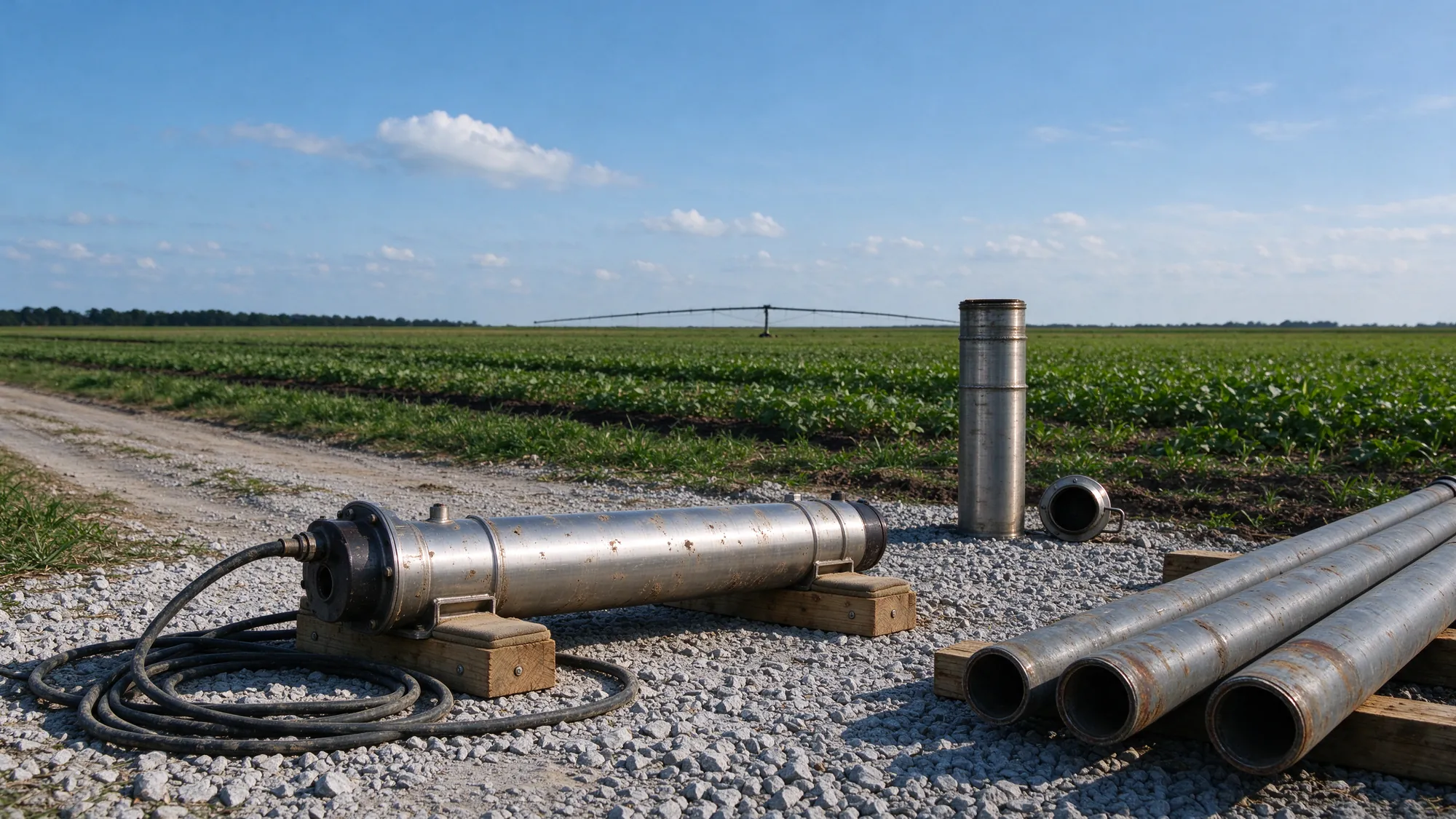
Farm and commercial wells often run larger submersibles or turbines, sometimes on three-phase power. Three-phase motors use magnetic starters, overload relays and phase protection rather than a simple pressure switch and capacitor. A lost phase or unbalanced voltage can damage a motor in minutes, so the electrical supply is tested as carefully as the pump. Larger systems may run on pressure switches, float controls on a storage tank, timers or variable-speed drives, and each needs its own diagnosis.
Planning around downtime
On a farm, a pump replacement is not just a repair; it is a gap in supply. Livestock need water every day, and irrigation in a dry spell cannot wait a week. The work is planned before the pump comes out: stored water or a temporary supply for animals, timing irrigation repairs between watering windows, and having parts lined up so a deep pull does not turn into two visits. Telling us early what depends on the well, and for how long it can be without water, shapes the plan.
Sizing to the well, not just the demand
A farm’s demand can be larger than a well can sustainably supply. A pump sized to the peak irrigation flow, on a well whose yield is smaller, will draw the water down to the intake and start pulling air or sand. The pump has to be matched to the well’s tested yield and water levels, and storage, staggered zones or a second well fill the gap where demand is higher. When the pump is out, the static and pumping levels are measured so the setting and size are based on the well as it is now.
Water quality for animals, crops and people
Livestock water, irrigation water and drinking water have different quality needs. Iron and sulfur that only stain a barn wall can foul drip irrigation and nursery systems. Bacteria matter wherever people drink the water. A farmhouse on the same well as the barn needs the same annual bacteria test as any home, and wells near animal operations and fields are worth testing for nitrate.
Businesses and public use
A business well that serves employees or customers may fall under different rules from a private household well. Under Virginia’s definitions, a system that serves piped water for human consumption to at least 15 service connections, or 25 or more people for at least 60 days a year, is a waterworks rather than a private well. Churches, campgrounds, schools and larger businesses on wells should confirm with the health department which rules apply before changing the system.
New wells and replacement wells
When a farm well has failed or a new supply is needed, a new well needs a VDH construction permit and has to meet setbacks from septic systems, animal areas and fuel or chemical storage. Large wells may also need the DEQ withdrawal permit. Old farm wells that are replaced have to be sealed under VDH rules.
Records worth keeping
For a farm or business well, a simple log pays for itself. Note the static water level and pumping level whenever the pump is out, the pump’s make, size and setting, the date of each repair, monthly water use if it is metered, and water test results. Over a few years, that log shows whether the well is holding up, whether the pump is wearing, and how close the operation is to the DEQ withdrawal threshold. It also makes every future repair faster, because the next visit starts with facts instead of guesses.
Seasonal patterns
Farm wells work hardest in late spring and summer, when irrigation and livestock demand peak at the same time as the water table is lowest. That is when undersized tanks short-cycle, worn pumps fall behind and pump settings with little margin start drawing air. A check before the season, with the pump’s amp draw, the pressure behavior and, where possible, the water level, catches most of those problems while there is still time to fix them without losing a crop or stressing animals.
Backup supply
For operations that cannot be without water, a backup matters as much as a good pump: a second well, a storage tank sized to cover a day or more of demand, or a generator large enough to start the pump during an outage. Each has trade-offs in cost and upkeep, and the right one depends on how the operation would cope with a day without water.
Who does the work
Farm and commercial well work is carried out by licensed and insured water well contractors certified through DPOR as water well systems providers.
What is included
- Assessment of demand: livestock, irrigation, process or household
- Electrical and control tests, including three-phase supply
- Pump pull, inspection and replacement
- Pump and controls sized to the well's tested yield
- Storage and pressure system review
- Water level and yield monitoring
- Disinfection and testing where water is consumed
- Planning to keep water available during work
Choosing between the options
| Use | What matters most | Typical set-up |
|---|---|---|
| Livestock | Reliability; no gap in supply | Submersible with storage or a backup supply |
| Crop and nursery irrigation | Flow at the needed pressure for hours | Larger submersible or turbine, sometimes three-phase |
| Small business or church | Drinking-water quality and pressure | Submersible with tank, treatment as tested |
| Food or process use | Water quality records | Testing plan and treatment as required |